How to Use Pinterest to Drive Traffic to Your Etsy Shop
Discover how to drive consistent traffic from Pinterest to your Etsy shop. Learn the traffic funnel, link strategy, and realistic timelines.
How to Use Pinterest to Drive Traffic to Your Etsy Shop
Every Etsy seller wants more traffic. The challenge is finding a source that does not require constant daily effort, that reaches buyers who are ready to spend money, and that actually compounds over time. Pinterest is that source, and it is dramatically underused by most Etsy sellers.
But driving traffic from Pinterest to Etsy is not as simple as posting a product photo with a link. There is a specific funnel at work, and understanding it changes how you approach the platform.
The Pinterest Traffic Funnel for Etsy
Pinterest traffic does not work like Google Ads or Instagram. There is no instant gratification. Instead, Pinterest operates on a discovery-save-click-buy funnel that plays out over days, weeks, or even months.
Here is how it works:
- Discovery: A user sees your pin in search results, their home feed, or in "more like this" suggestions. This is an impression.
- Engagement: The user stops scrolling. Your pin caught their attention. They might zoom in, read the description, or save it to a board.
- Click: The user taps through to your Etsy listing. This is the traffic event you care about.
- Purchase: Some percentage of visitors buy. This depends on your listing quality, pricing, reviews, and how well your listing matches what the pin promised.
The critical insight is that steps 2 and 3 can happen days or weeks after step 1. Someone saves your pin to their "Kitchen Renovation Ideas" board in January. They come back to that board in March when they are actually renovating, and that is when they click through and buy. This delayed conversion is why Pinterest traffic looks underwhelming at first but grows powerful over time.
How Pinterest Users Discover Products
Understanding where your pins appear helps you optimize for each channel.
Pinterest Search is the highest-intent discovery channel. Someone typing "personalized dog collar leather" is actively looking for that product. Your pin shows up if your keywords match. This is why Pinterest SEO is non-negotiable. Search-driven pins tend to have the highest click-through rates because the intent is already there.
Home Feed is algorithmically curated based on a user's interests, past saves, and engagement patterns. Getting into home feeds requires Pinterest to understand what your pin is about (good keywords, clear imagery) and to see that similar users engage with your content. Home feed impressions are high volume but lower intent.
Related Pins appear when someone clicks on a pin and scrolls down. Pinterest shows visually and topically similar pins. This is powerful for product discovery because the user has already shown interest in something similar. If your product photos are strong and your keywords are relevant, you will appear in related pin results for competitors and complementary products.
Shopping Search is Pinterest's dedicated product search experience. If you have rich pins enabled through your claimed Etsy shop, your products can appear here with pricing and availability. This is one of the highest-converting placements on the platform.
Optimizing Your Pin for Click-Throughs
Getting impressions is the easy part. Getting clicks requires intentional design and copywriting.
Create visual curiosity. The pins that get the most outbound clicks are ones that promise more than they show. A pin showing one angle of a beautifully styled living room with text saying "See the full room transformation" drives more clicks than a pin that shows everything. For product sellers, show the product in context but make the viewer want to see more angles, colors, or details.
Use text overlays strategically. Text on your pin should add context that the image alone does not provide. Price points ("Under $30"), social proof ("Over 2,000 sold"), and specificity ("Available in 14 colors") all give people reasons to click. Keep text to 6-8 words maximum. It needs to be readable at thumbnail size on a phone screen.
Write descriptions that sell the click. Your pin description is not just for SEO. It is your opportunity to give someone a reason to tap through. Lead with the benefit, include relevant details, and end with a soft call-to-action. "Hand-stamped sterling silver ring, customized with your name or date. Perfect for anniversaries and birthdays. Tap to see all font options and order yours."
Make your pin title specific. "Personalized Sterling Silver Name Ring - Custom Engraved" outperforms "Beautiful Ring" in both search and click-through rate. Specificity builds confidence that the link leads somewhere relevant.
Link Strategy: Where to Send Traffic
This seems obvious, but many sellers get it wrong.
Always link to the specific product listing. Not your shop homepage. Not a section page. The exact listing that matches what the pin shows. Every extra click between "I want this" and "Add to cart" loses you customers. If your pin shows a blue ceramic mug, the link should go to the blue ceramic mug listing.
One exception: If you have a collection or variation-heavy product, linking to a well-organized section page can work if the pin explicitly promotes the collection ("Our full line of botanical prints").
Use rich pins. When you claim your Etsy shop on Pinterest, your product pins automatically pull in current pricing, availability, and your shop name. This adds credibility and makes the pin more actionable. Users can see the price before they click, which pre-qualifies the traffic. The people who click through after seeing the price are more likely to buy.
Check your links regularly. Sold-out listings, deactivated products, and broken links waste all the effort you put into creating pins. Once a month, review your top-performing pins and make sure the links still work. If a listing sold out, either relist or update the pin link to a similar product.
How Long Pinterest Traffic Takes to Build
This is where most Etsy sellers give up too early. Pinterest is not TikTok. You will not see viral traffic spikes in week one. But the trade-off is that Pinterest traffic is far more durable and predictable once it builds.
Here is a realistic timeline for a new account pinning consistently (5-10 pins per day):
Month 1-2: The Foundation Phase
Expect very little. Impressions will be low, clicks will be in the single digits per day, and you will wonder if it is working. It is. Pinterest is learning about your account, categorizing your content, and testing your pins with small audiences. This phase is where most sellers quit.
What to focus on: Creating quality pins, writing keyword-rich descriptions, building out your boards. Do not change your strategy yet. There is not enough data.
Month 3-4: Early Traction
You will start seeing consistent impressions. Some pins will begin appearing in search results. Clicks will increase from single digits to perhaps 20-50 per day depending on your niche. You will notice that certain pin designs and topics perform better than others.
What to focus on: Double down on what is working. Create more pin variations for your top-performing products. Start analyzing which keywords drive the most impressions.
Month 5-6: Compounding Begins
This is where it gets interesting. Your older pins are now established in search results. New pins benefit from your account's growing authority. Daily clicks might reach 50-150+. You will start seeing direct correlation between Pinterest traffic and Etsy sales.
What to focus on: Seasonal planning (you should be creating pins for holidays 45-60 days out), expanding into new keywords, creating fresh pin designs for your entire catalog.
Month 7-12: Sustainable Growth
Your Pinterest account is now a reliable traffic source. Older pins continue driving traffic without any additional effort. Each new pin you create adds to a growing library of content that works for you around the clock. Many consistent Etsy sellers see Pinterest become their number one external traffic source by this point.
Important caveat: These timelines assume you are pinning consistently, creating quality original pin designs (not just reposting the same image), and targeting relevant keywords. Inconsistent pinning or poor-quality content will extend these timelines significantly.
Maximizing the Compounding Effect
The real power of Pinterest is that your effort accumulates. A pin you create today might drive traffic for the next two years. Here is how to maximize that compounding:
Create evergreen content. Pins tied to evergreen keywords ("handmade leather wallet," "nursery wall art") will drive traffic indefinitely. Seasonal pins are valuable too, but they only work a few months per year. Balance your content mix toward evergreen.
Refresh your top performers. When a pin performs well, create 3-5 new designs for the same product and URL. Different images, different text overlays, different angles. Each variation is a new entry point into search results and feeds. This is one of the most efficient things you can do because you already know the product and keywords convert.
Stay consistent through slow periods. The sellers who build real Pinterest traffic assets are the ones who pin through the quiet months. It is tempting to stop when you are busy with orders and resume when sales slow down, but that inconsistency hurts your account's authority. Scheduling tools exist specifically to solve this problem. Batch your pin creation during slow periods and schedule them out weeks in advance.
Build topical authority. Pinterest rewards accounts that are clearly about something. An account that pins jewelry, recipes, and travel tips confuses the algorithm. An account that pins handmade jewelry, jewelry styling tips, and gift guides for jewelry lovers builds clear topical authority, and Pinterest will show your pins to more jewelry-interested users.
Tracking What Matters
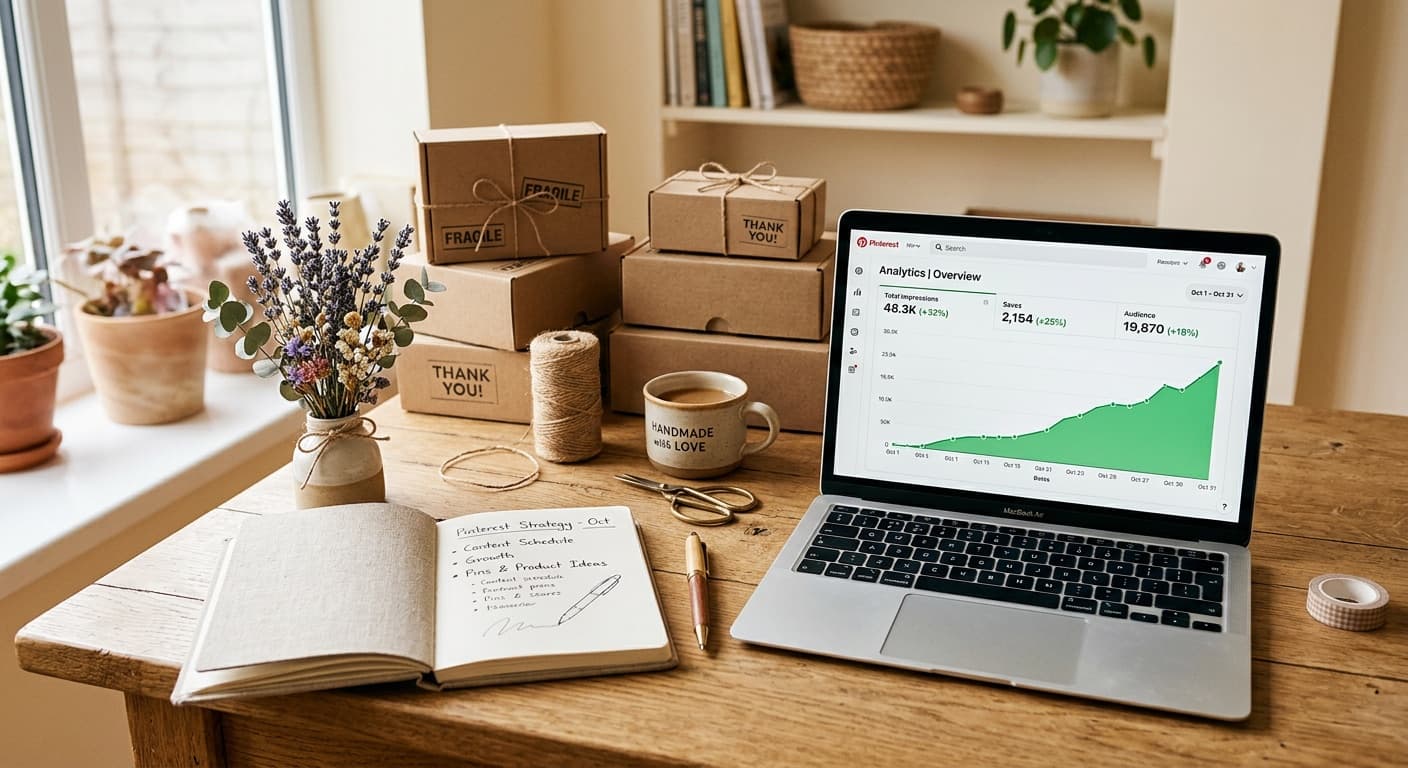
Pinterest analytics shows impressions, saves, and clicks. But the metric that matters for your business is revenue from Pinterest traffic.
Use UTM parameters on your Etsy links to track which pins drive actual sales. The format is simple: add ?utm_source=pinterest&utm_medium=pin&utm_campaign=product-name to your Etsy listing URLs. This lets you see Pinterest-driven revenue in Etsy's traffic stats.
Track your click-through rate (outbound clicks divided by impressions) to understand how effectively your pins convert attention into traffic. A healthy CTR for product pins is 1-3%. If you are below 1%, your pin designs or descriptions need work. If you are above 3%, you are doing something right and should study those pins carefully.
Put Your Pinterest on Autopilot
Consistent pinning is the single biggest factor in building Pinterest traffic, but it is hard to do manually when you are running an Etsy shop. PetalBoard lets you batch-create pins, write AI-assisted captions with your brand voice, and schedule everything to post at optimal times. Get started free at petalboard.com and start building the traffic asset your Etsy shop deserves.